Why most industrial websites lose the buyer

Most industrial websites are built like brochures. The buyer who lands on them is an engineer or purchasing manager with a specific question, and the site makes them dig for the answer or call to get it.

The usual problems:

  • Specs are locked in PDFs. A buyer can’t filter by bore size, voltage or material, so they leave for a distributor’s site that lets them.
  • No path for the whole buying team. The engineer needs drawings, procurement needs lead times and certifications, the plant manager needs proof it works. One generic “Contact Us” form serves none of them.
  • Quote requests go nowhere. Forms land in a shared inbox, sit for days and never reach the rep who owns the territory.
  • Distributors and reps are invisible. Buyers who must purchase through a channel partner can’t find the nearest one.
  • Search engines can’t read it. Product data trapped in images and PDFs never ranks, so buyers searching by part type or spec never find you.

Industrial website design fixes these at the structure level, before a single color is picked.

Industrial website design services

Searchable product and spec catalogs

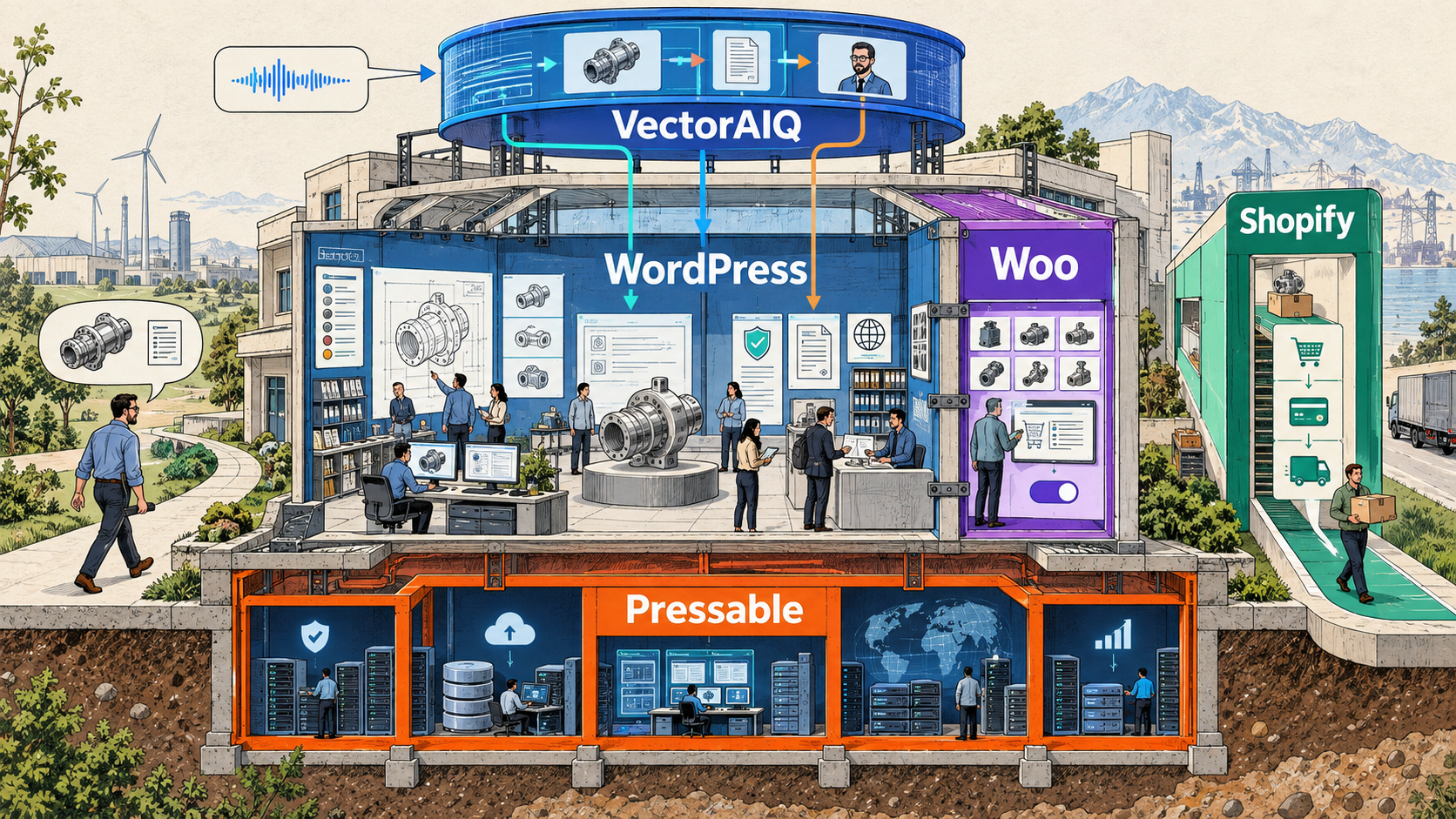
We turn your product line into a structured catalog that buyers can filter by the attributes they actually specify: dimensions, materials, ratings, standards, compatible parts. Each product gets its own indexable page, so a search for a part type or spec can land directly on it. For most industrial clients we build the catalog on WooCommerce in catalog-only mode: full product data and no checkout.

CAD, drawing and data sheet libraries

Engineers want the file, not a sales call. We build download libraries for CAD models, 2D drawings, data sheets, manuals and certifications, attached to the right product and searchable on their own. You can choose which files are public and which need a short form, so downloads become qualified leads.

Request-for-quote forms that reach the right rep

Quote forms capture what your estimators need the first time: part numbers, quantities, materials, drawings and timelines. Submissions route by product line or territory into your CRM, including Salesforce and HubSpot, so the right rep sees a complete request within minutes. A quote basket lets buyers add several products to one request, the same way a shopping cart works.

Distributor and rep locators

If you sell through channel partners, buyers need to find them fast. We build searchable maps and lists by region, product line or partner type, fed from a source you can update without a developer.

Certifications and compliance up front

ISO 9001, AS9100, UL listings, RoHS, ITAR registration: whatever qualifies you for a buyer’s approved-vendor list gets its own visible place on the site, with downloadable certificates. Procurement teams check these first, and so do AI search tools deciding who to recommend.

ERP, PIM and CRM integrations

Your product data already lives somewhere. We connect the website to your ERP or PIM so specs, part numbers and availability update from the source instead of being retyped. Leads and quote requests flow the other way, into your CRM.

Who we build industrial websites for

  • Equipment and machinery manufacturers selling complex, configurable products
  • Automation, controls and instrumentation companies with deep spec sheets
  • Industrial technology makers: lasers, optics, sensors, test and measurement
  • Engineered components and parts suppliers with large SKU counts
  • Industrial distributors and suppliers representing several manufacturers
  • Process equipment for chemical, food, water and energy plants

If you make parts to customer specs, see our web design for manufacturing companies. For aerospace and defense suppliers, see aerospace and defense web design. Engineering firms selling services rather than products should start with web design for engineering firms.

Industrial SEO and AI search visibility

Industrial buyers search by problem, part type and spec, and more of them now ask ChatGPT, Gemini or Google’s AI Overviews before they search at all. Industrial SEO means making your technical depth readable by both search engines and AI:

  • Individual pages for products, series and applications, not one long PDF
  • Spec tables in real HTML that search engines can read and quote
  • Product and organization schema markup so search engines understand what you make
  • Application and industry pages that answer “what’s the right X for Y” questions
  • Technical SEO: fast load times, clean site architecture, correct redirects when an old site is replaced

Learn more about our search engine marketing for industrial companies.

Built on WordPress and WooCommerce

We build most industrial websites on WordPress with WooCommerce for the catalog, hosted on Pressable, where we’re a partner. You own your platform and your data, there are no per-transaction fees, and WooCommerce’s product data model handles the attributes and variations industrial catalogs need.

We’re also a Shopify partner, and we’ll tell you when Shopify is the better fit. For complex industrial catalogs it rarely is: here’s why we recommend WordPress over Shopify for manufacturing and B2B industrial.

Case study: Photonics Industries International

Photonics Industries International designs and manufactures industrial lasers. Their buyers compare detailed specifications across laser families before they ever talk to sales.

We built their site on WooCommerce in catalog-only mode: every laser series has a structured product page with full specifications and no checkout or payment step, because nobody buys an industrial laser with a credit card. The site runs entirely on Pressable managed hosting.

We’ve built the same approach for B2B catalogs outside industrial too: Couristan’s catalog turns add-to-cart into a quote basket that feeds Salesforce.

How an industrial website project runs

  1. Discovery. We interview sales, engineering and a few customers to learn how your buyers actually choose.
  2. Catalog and content audit. We map every product, attribute, file and certification, and decide where each lives.
  3. Architecture and design. Sitemap, catalog filters and page templates, designed for the engineer and the purchasing manager.
  4. Build and integrations. WordPress and WooCommerce build, data import from your ERP or PIM, CRM routing for quotes.
  5. Launch and SEO migration. Every old URL redirected, rankings protected, Search Console monitored.
  6. Ongoing support. Hosting, updates, new products and continued SEO.

Industrial web design FAQ

What makes industrial web design different from regular B2B web design?

Industrial websites are built around product data. Buyers need to filter and compare specifications, download CAD files and certifications, and request quotes for configured products. That means more structure, deeper catalogs and integrations with ERP and CRM systems than a typical B2B service website.

Can our catalog live on the website without online ordering?

Yes. We build WooCommerce catalogs in catalog-only mode: full product pages, filters and downloads, with no prices, cart or checkout unless you want them. Buyers request a quote instead.

Can quote requests go straight into Salesforce or HubSpot?

Yes. Quote and contact forms can create leads or opportunities in Salesforce, HubSpot and most other CRMs, routed by product line or territory.

Can you import our product data from our ERP or spreadsheets?

Yes. We import from spreadsheets, PIM systems and most ERPs, and can set up ongoing syncs so the site updates when your source data changes.

Will we lose our Google rankings when we redesign?

Not if the migration is planned. We map every existing URL to its new home, set up 301 redirects and monitor Search Console after launch.

Do you work with industrial companies nationwide?

Yes. We run projects remotely for industrial companies across the US.

Ready to build a website your buyers can actually use?

Tell us about your products, your buyers and your current site. We’ll come back with a clear scope and quote.