
The Silent Crisis in Digital Discovery
B2B companies are facing an invisible threat. While your marketing team celebrates stable search rankings and your development team maintains a technically sound website, something fundamental has changed in how potential customers discover businesses like yours. The shift is so recent that many organizations haven’t noticed the warning signs—but the data tells an unmistakable story.
Consider this: despite Google processing more searches than ever before—between 9.1 and 13.6 billion daily searches—website traffic across industries is in freefall. This paradox, which researchers are calling “The Great Decoupling,” marks the most significant transformation in digital marketing since search engines became the primary tool for business research.
The numbers demand attention. According to comprehensive industry research, 60% of searches now conclude without any user clicking through to a website. For mobile users, who represent the majority of searchers, that figure climbs to 77.2%. Your carefully crafted content, your thought leadership, your competitive differentiators—all of it risks being summarized and delivered by AI systems before prospects learn your company exists.
Understanding the AI Overview Revolution
The Rapid Expansion of AI-Generated Summaries
Google’s AI Overviews represent the primary catalyst behind declining website traffic. These AI-generated summaries, which provide direct answers without requiring users to visit source websites, have expanded at an unprecedented rate. Data from Semrush’s comprehensive AI Overviews study reveals that appearances grew from 6.49% of queries in January 2025 to 13.14% by March—more than doubling in just eight weeks.
If this trajectory continues, industry analysts project AI Overviews could appear for one in four searches by year’s end. For B2B companies, the implications extend beyond simple traffic metrics. These summaries fundamentally alter the discovery process, inserting AI interpretation between your expertise and potential customers.
The Click-Through Rate Collapse
The impact on user behavior has been devastating. Research conducted by the Pew Research Center analyzing 900 participants found that searches featuring AI Overviews experience click-through rates of just 8%, compared to15% for traditional results. This 47% reduction represents more than a statistical anomaly—it’s a structural change in how users interact with search results.
Perhaps most concerning for content creators and B2B marketers: only 1% of users click on sources cited within AI Overviews. Your content may power the AI’s answer, providing the expertise and insights users seek, yet you receive virtually no recognition, traffic, or opportunity to establish direct relationships with prospects.
Real-World Impact: Companies Facing the Crisis
Publisher Traffic Data Reveals Industry-Wide Declines
The abstract statistics become tangible when examining real companies. Digital Content Next, an organization representing major publishers including The New York Times, Condé Nast, and Vox, compiled data from 19 member companies. Their findings show a median 10% year-over-year decline in referral traffic from Google Search during May and June 2025.
Breaking down by category reveals even starker patterns. News organizations experienced a 7% median decline, while non-news content publishers saw traffic drop 14%. Major news outlets suffered particularly acute losses: CNN’s traffic declined between 27-38%, Forbes dropped 50%, and Business Insider fell 40-48%.

The HubSpot Case Study: A Warning for B2B Companies
The B2B marketing community took particular notice when HubSpot experienced catastrophic traffic losses. The marketing automation platform, renowned for its SEO expertise and thought leadership content, saw organic traffic plummet 70-80% between late 2024 and early 2025. Monthly organic visits crashed from approximately 13.5 million to under 7 million, with some months dipping to 6 million.
HubSpot’s experience proves particularly instructive because it demonstrates that even industry leaders with sophisticated SEO teams aren’t immune. The company’s CEO, Yamini Rangan, publicly acknowledged during quarterly earnings that organic search traffic is “declining globally” and attributed losses directly to AI Overviews providing answers without driving clicks.
The Strategic Misstep:
Analysis of HubSpot’s content strategy reveals a critical error that many B2B companies should avoid. The company had built traffic on broad, high-volume keywords with minimal connection to their core CRM offering. Content about “famous sales quotes,” “cover letter examples,” and unrelated topics drove impressive visitor numbers but failed to establish genuine expertise in their domain.
When Google’s March 2024 algorithm update began prioritizing content demonstrably tied to a website’s core expertise and experience, HubSpot’s tangentially related content lost value. The lesson: generic, traffic-focused content becomes increasingly vulnerable as AI systems get better at evaluating genuine expertise.
The Pivot:
HubSpot’s response illuminates the path forward. The company now reports that blog traffic generates just 10% of leads, down from a historical majority. They’ve refocused on being “cited in LLMs more than any other CRM” and measure success through AI citation frequency and conversion quality rather than raw traffic numbers.
Vertical-Specific Vulnerability
Different industries face varying degrees of AI Overview penetration. Between January and March 2025, certain verticals experienced explosive growth in AI-summarized queries:
- Real Estate: Keywords triggering AI Overviews increased 258%
- Restaurants: Growth of 273%
- Transportation: Increase of 223%
- Retail: Rise of 206%
- Science Topics: Growth of 22.27%
- Health Information: Increase of 20.33%
- Legal and Government: Rise of 15.18%
For B2B organizations, these statistics carry particular significance. Research indicates 88.1% of queries triggering AI Overviews are informational in nature—precisely the type of content B2B companies create to demonstrate thought leadership, educate prospects, and establish authority.
The Parallel Reality: AI Adoption Accelerates
Enterprise Investment Surges
While website traffic declines, a parallel trend accelerates: enterprise AI adoption. This isn’t a temporary experiment that will reverse—it represents fundamental transformation in business operations and consumer behavior.
McKinsey’s 2025 State of AI research found 88% of organizations now use AI in at least one business function, up from 78% the previous year. In the United States specifically, firm AI adoption more than doubled in two years: from 3.7% in fall 2023 to 9.7% in August 2025.
Financial commitment mirrors adoption rates. Enterprise AI spending reached $37 billion in 2025, representing 3.2x year-over-year growth from $11.5 billion in 2024. Gartner projects worldwide generative AI spending will total $644 billion in 2025, a 76.4% increase.
User Behavior Transforms
Consumer adoption patterns reinforce enterprise trends. AI tools now serve 378 million people globally, with 64 million new users added in 2024 alone. ChatGPT reports 400+ million weekly users, representing 4x growth in 15 months. Among professionals, 27% of white-collar workers use AI frequently in daily work, up 12 percentage points from 2024.
B2B Buyer Behavior Shifts
The transformation extends beyond internal business operations to fundamentally reshape B2B buyer behavior. In 2023, 13 million Americans used AI for search. Projections suggest that number will reach 90 million by 2027.
Gen Z, who will increasingly occupy B2B decision-making roles, leads this behavioral shift with 31% of searches occurring on AI platforms like ChatGPT. Most significantly, 80% of consumers now rely on AI-written results for approximately 40% of searches.
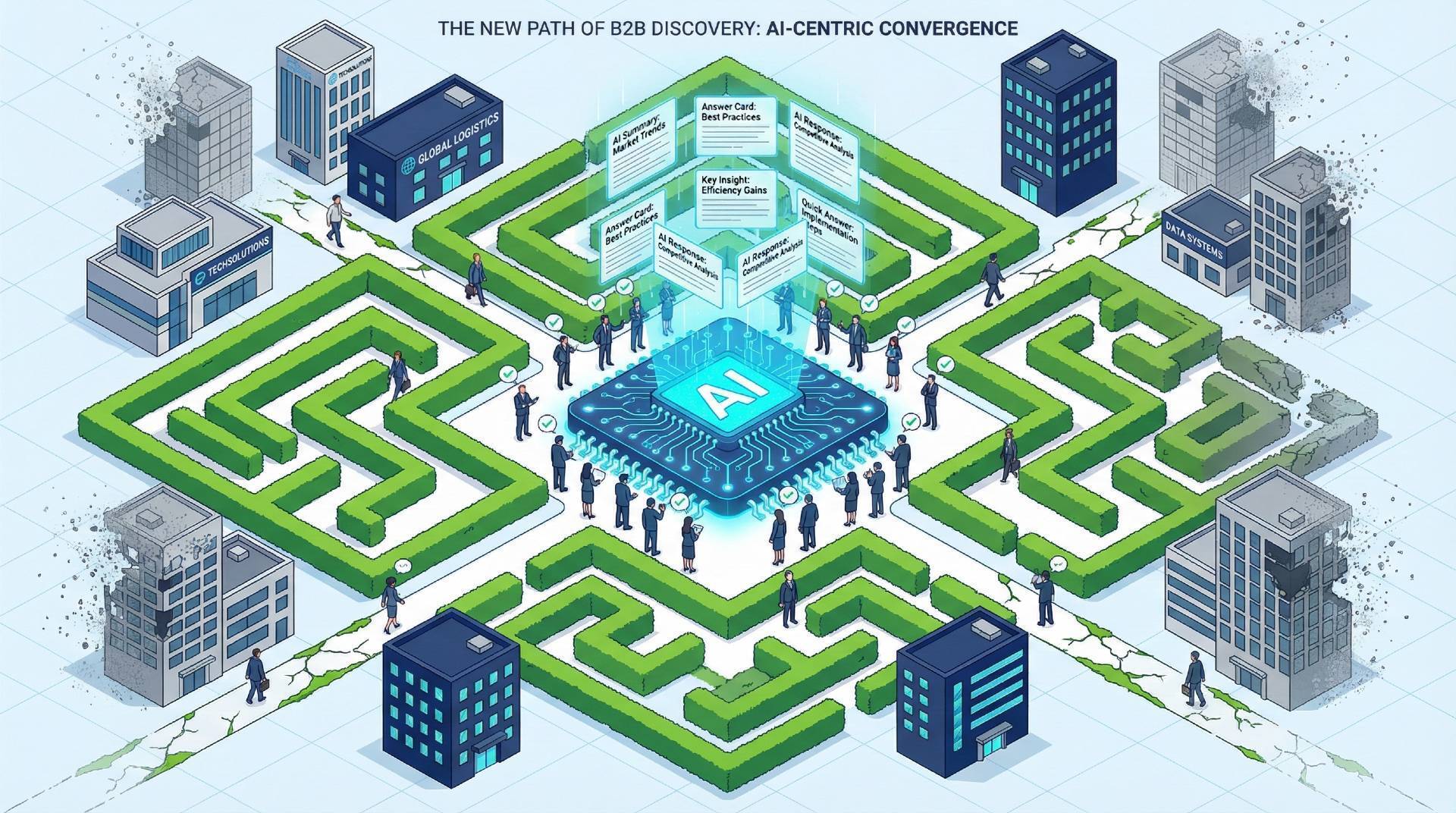
Your potential customers increasingly discover solutions, evaluate vendors, and make preliminary decisions through AI-powered search—often completing substantial research before visiting any company website. If your business isn’t optimized for AI visibility, you risk invisibility during the most critical awareness and consideration stages.
The ROI Justification
Organizations aren’t investing billions in AI based on speculation. Thomson Reuters’ Future of Professionals Report found 53% of professionals already see ROI directly or indirectly tied to AI investment. The average return: 3.7x for every dollar invested in generative AI.
Productivity gains provide tangible justification. Companies report 15-30% improvements, with some targeting 80% increases. OpenAI’s enterprise survey found 75% of workers report AI improved either speed or quality of their output.
Strategic Implications for B2B Organizations
The Zero-Click Economy Creates New Challenges
The fundamental challenge is clear: AI systems answer questions without directing users to source websites. Traditional awareness-building content no longer generates traffic. Educational resources, implementation guides, and thought leadership—historically the foundation of B2B content marketing—get summarized and delivered without brand attribution.
However, within this crisis lies strategic opportunity. Being consistently cited by AI systems represents a new form of brand authority. Organizations focusing on becoming trusted AI sources achieve better long-term outcomes than those fixated on traffic volume alone.
The Competitive Advantage Gap Widens
Thomson Reuters’ research reveals a stark divide emerging among organizations. Companies with clear AI strategies linked to business goals are twice as likely to see revenue growth compared to those with informal approaches. Strategic adopters are 3.5 times more likely to experience critical AI benefits versus organizations with no AI adoption plans.
The warning carries weight: organizations lacking AI strategies risk falling behind as competitors transform operations. Success requires not just adoption but strategic planning to reinvest productivity gains into innovation, efficiency, and growth.
Currently, only 22% of organizations maintain visible AI strategies. This statistic represents enormous opportunity for forward-thinking B2B companies to establish competitive advantage before markets saturate with AI-optimized competitors.
The MAXBURST Approach: Intelligent Experience Optimization
Why Traditional Development Fails
Conventional web development approaches fail because they were architected for a world where humans exclusively consumed website content. Today’s reality demands recognition that AI systems are equal—or in some cases, primary—consumers of your digital presence.
Traditional websites lack:
- Proper structured data implementation
- Content organization that signals expertise to AI systems
- Critical E-E-A-T (Experience, Expertise, Authoritativeness, Trustworthiness) signals
- Strategic content structure designed for machine comprehension
- Semantic HTML that clearly communicates hierarchy and relationships
Our Intelligent Experience Optimization (IXO) Framework
MAXBURST’s IXO framework fundamentally rethinks web development for the AI era, building AI-readiness into project foundations rather than treating it as an afterthought.
Strategic Foundation:
Before design commences, we conduct comprehensive analysis:
- Data-driven user behavior research
- AI-oriented keyword analysis
- Content structure planning for machine comprehension
- Entity relationship mapping
- Content hierarchy planning that serves both human and AI navigation
Technical Implementation:
We build AI-friendly architecture from the ground up:
- Semantic HTML structure
- Advanced schema markup implementation
- Efficient crawl paths for AI systems
- Clean, maintainable code architecture
- Strategic content clustering and topic modeling
Generative Search Optimization:
Content structure targets optimal AI feature appearance:
- Featured snippet optimization
- Answer block formatting
- Clear, structured data presentation
- Strong entity associations
- Explicit intent clarity
Authority Signal Integration:
We embed credibility markers throughout:
- Clear authorship identification
- Expert credential display
- Case study and experience integration
- Proper source attribution
- Professional certifications and affiliations
The S.T.E.P. Process Implementation
Our systematic four-phase process ensures AI optimization permeates every development stage:
Strategy Phase: AI crawl path planning, content structure strategy development, technical requirement analysis, search intent alignment, and quality benchmark establishment. Every subsequent decision supports both human users and AI comprehension.
Technology Phase: Structured data framework implementation, comprehensive schema markup deployment, AI-friendly architecture construction, performance optimization, and technical SEO foundation establishment.
Execution Phase: Clean code development, strategic content structure implementation, AI visibility feature optimization, comprehensive quality assurance, and mobile-first responsive design integration.
Performance Phase: Continuous crawl behavior analysis, AI feature performance tracking, content effectiveness monitoring, ongoing optimization implementation, and regular AI-readiness updates as systems evolve.
Adapting to the New Reality
Redefining Success Metrics
Traffic may decline while business grows. Success requires shifting from traffic-based to outcome-based metrics:
- Citation frequency replaces pageview counts as an awareness indicator
- Conversion rate becomes more critical than visitor volume
- AI visibility stands alongside traditional search rankings
- Brand mentions in AI responses serve as primary awareness metrics
Case studies validate this approach. A B2B SaaS startup achieved 367% traffic growth through deeply specialized, industry-specific content positioning them as niche authorities. The content required genuine expertise rather than generic advice AI could replicate.
Research analyzing 3,000 businesses found companies maintaining or growing revenue despite traffic declines share two characteristics: an omnichannel approach creating seamless experiences across touchpoints, and strong conversion rate optimization transforming existing traffic into customers regardless of volume.
Multi-Platform Strategy Becomes Essential
Exclusive reliance on Google organic search is no longer viable. Successful B2B organizations build presence across multiple discovery channels:
- LinkedIn for B2B thought leadership and professional engagement
- YouTube as the second-largest search engine, with content AI struggles to fully summarize
- Reddit and communities for authentic conversation and peer recommendations
- Email and newsletters for owned channels independent of algorithms
- Alternative AI search engines like Perplexity and ChatGPT with different optimization requirements
Video content deserves particular attention. AI has advanced more slowly in video summarization versus text, creating differentiation opportunities. Organizations focusing on strategic, high-quality video content experience strong engagement despite text-based traffic declines.
The Cost of Delayed Action
Timeline Projections
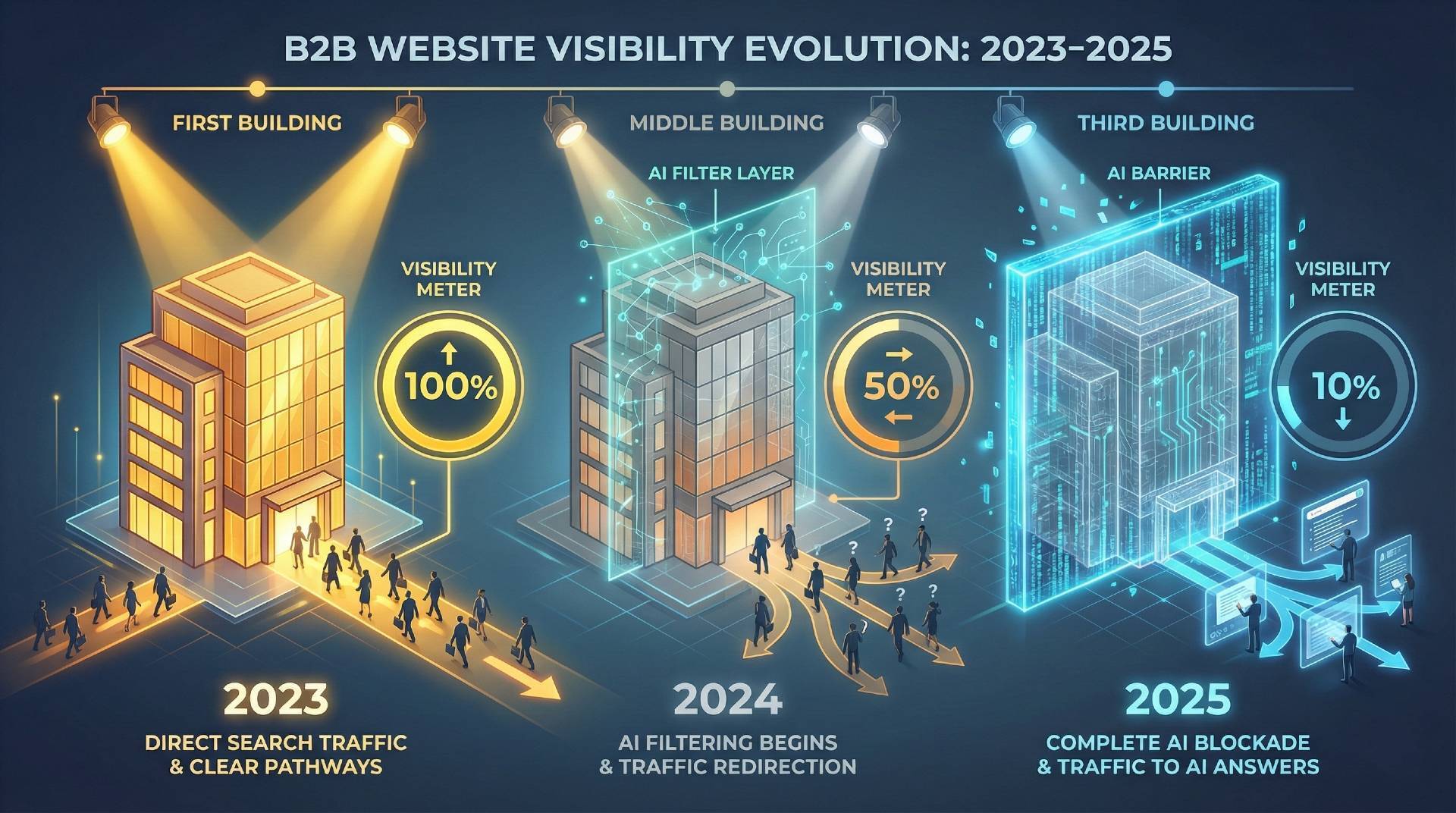
Current projections suggest AI Overviews will reach 20-25% of queries by year-end 2025. Zero-click searches may approach 70% of all searches. Navigational queries—where users search specifically for your company—increasingly receive AI treatment, putting even brand traffic at risk.
Competitive disadvantage compounds rapidly. Organizations without AI strategies are 3.5 times less likely to see benefits versus strategic adopters. Winner-take-most dynamics intensify, with brand traffic and authority concentrating among the largest, most AI-visible companies.
Mid-tier companies face particular pressure—large enough for significant costs yet not large enough to command brand awareness cutting through AI summarization.
Technical Debt Accumulates
Retrofitting AI-friendly architecture into existing websites costs significantly more than building correctly initially. Content restructuring requires intensive labor, comprehensive schema implementation across existing sites carries high costs, and substantial opportunity cost accrues during transition periods while competitors operate with AI-optimized infrastructure.
Most critically, competitors establishing AI citation authority first create market positions difficult to overcome. As brand awareness declines without AI presence and lead generation capabilities diminish, recovering lost ground in AI systems becomes progressively harder. AI systems learn from patterns—consistent competitor citation as authorities while you remain absent reinforces over time.
Future Outlook: 2026 and Beyond
Near-Term Developments (2025-2026)
AI Overviews will likely reach 25%+ of queries, with zero-click searches stabilizing around 65-70%. Commercial intent queries will increasingly receive AI coverage as Google balances user experience with revenue needs. Platform diversification shifts from optional to mandatory for digital survival.
Medium-Term Evolution (2026-2028)
AI-first content discovery becomes the primary information-seeking channel. 75% of survey respondents anticipate using AI tools like ChatGPT for customer response generation. 44% expect AI usage for multilingual content generation, fundamentally changing global B2B communication. Citation-based revenue models may emerge as publishers seek sustainable business models in the zero-click era.
Long-Term Transformation (2028-2030)
We may witness API-based licensing where AI systems compensate content access, similar to streaming service licensing models. Revenue sharing for AI citations could emerge, following patterns similar to YouTube monetization. Premium membership models with AI-resistant content—so specialized or valuable that adequate summarization proves impossible—will likely proliferate. Digital discovery completes transformation from link-based web to AI-mediated information ecosystem.
Characteristics of Thriving Organizations
Organizations succeeding in the AI era will share common traits:
- Treating AI as strategic initiative rather than tactical tool
- Investing in genuine expertise and first-hand experience AI cannot replicate
- Building omnichannel presence beyond search engines
- Focusing on conversions and business outcomes over vanity metrics
- Continuously adapting to AI evolution rather than awaiting stability
Maintaining quality standards AI cannot replicate
Taking Action: Your Path Forward
Immediate Steps
The competitive window narrows daily. Each month of delay allows competitors to establish AI visibility while your brand becomes progressively less discoverable. Technical debt grows larger, and opportunity cost from lost leads and diminished awareness compounds.
Essential Actions:
- Assess current AI visibility: Search for your key topics in ChatGPT, Perplexity, and Google’s AI Overviews to understand current positioning
- Evaluate website AI-readiness: Conduct structured data testing and schema validation to identify gaps
- Develop comprehensive strategy: Address both immediate optimization needs and long-term AI evolution
- Partner with experts: Work with specialists who understand the transformation and maintain proven frameworks
- Act decisively: Execute before competitive disadvantage widens further
The MAXBURST Partnership
The shift from traditional search to AI-mediated discovery represents the most significant change in digital marketing since Google’s emergence. Organizations recognizing this reality and adapting strategically will thrive. Those clinging to outdated approaches will watch visibility—and business—erode.
At MAXBURST, we’ve built our entire methodology around this new reality. Our IXO framework and S.T.E.P. process aren’t merely prepared for the AI era—they’re designed specifically for it.
Our approach delivers:
- Future-proof development anticipating AI evolution rather than reacting to change
- Strategic partnership rather than transactional vendor relationships
- Proven alignment with Google’s quality standards and AI requirements
- Continuous optimization maintaining pace with AI advancement
We position ourselves as long-term digital partners invested in ongoing success beyond project completion. Our integrated team eliminates silos—digital marketing strategists, UX specialists, designers, and developers collaborate from day one, ensuring SEO, content strategy, and conversion optimization aren’t afterthoughts but foundational elements.
The Choice Is Yours
Organizations with visible AI strategies are twice as likely to see revenue growth. The question isn’t whether to adapt—it’s whether you’ll lead or follow the transformation.
Will your company lead the market into the AI-first future, or watch from the sidelines as others capture the opportunities?
The time to decide is now. The infrastructure you build today determines your visibility tomorrow.
Contact MAXBURST to learn how our Intelligent Experience Optimization approach ensures your business remains visible and competitive in an AI-driven world.